You Are There
The Idea That Made It Work
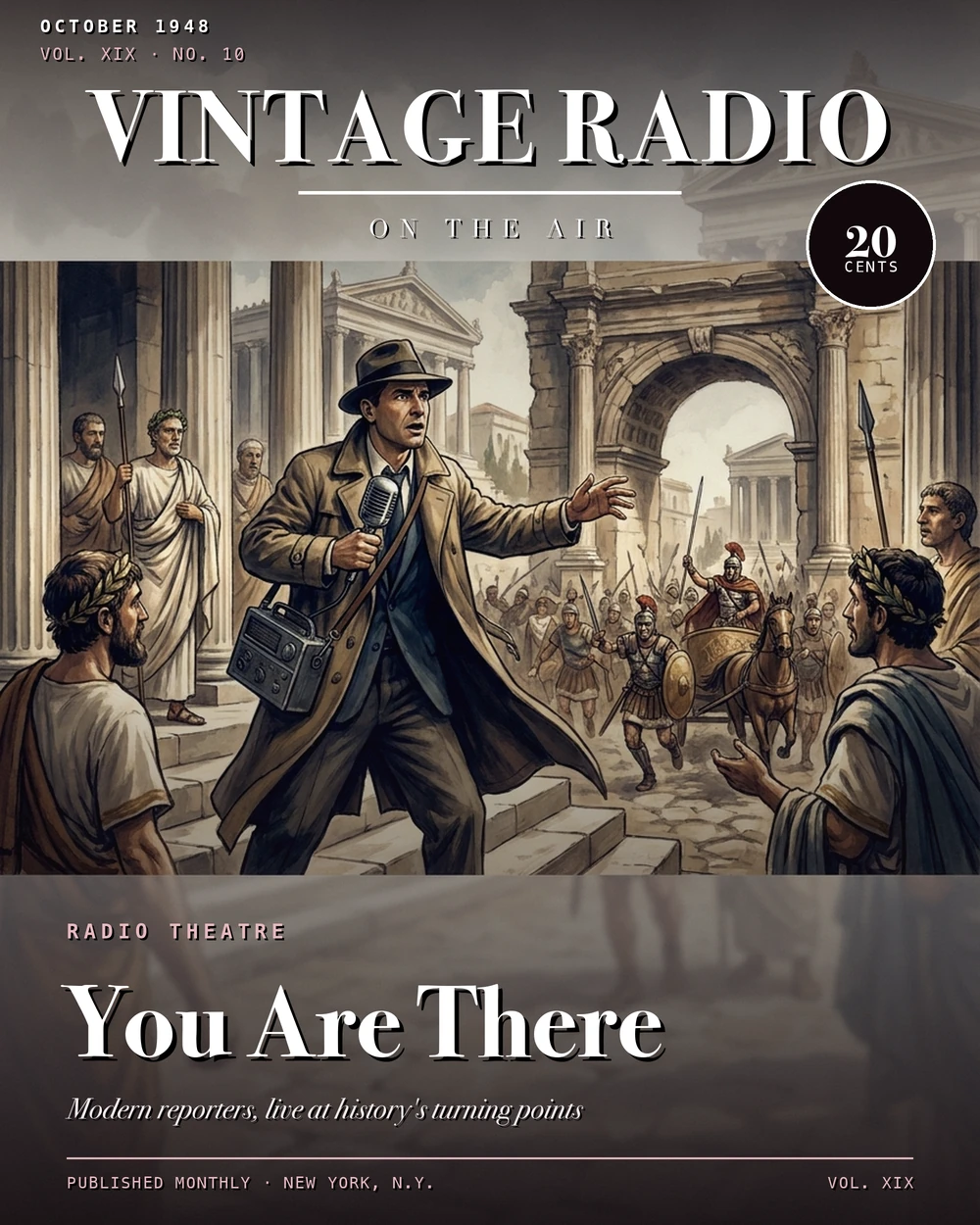
The premise was simple enough to explain in a sentence and strange enough to stick with you: every week, the entire CBS News apparatus — anchorman, field reporters, analysts, bulletin interruptions and all — picked up and traveled back through time to cover a great moment in history as though it were breaking news. A reporter outside Ford's Theater on the night Lincoln was shot. Another at the Bastille in 1789. Correspondents inside the Alamo. A man on a grassy hillside three thousand years ago watching the fall of Troy. The show's opening tagline set the terms: CBS's microphone was present at a historically significant moment, and at the end of the setup — "YOU ARE THERE."
Creator Goodman Ace, born Goodman Aiskowitz in Kansas City in 1899, came up with the concept in 1947 while running the CBS School of Comedy Writers, a network initiative aimed at challenging NBC's dominance in comedy. The irony is that his most enduring creation wasn't a comedy at all. Ace handed weekly production duties off to Robert Lewis Shayon, who served as producer-director for the entire run, while Ace moved on to other work. Shayon brought the show to life with a team of writers — Irve Tunick, Joseph Liss, and Michael Sklar — and sound effects work by Jim Rogan. The series was described in its own promotional framing as being based on "authentic fact and quotation," which gave the reporters something grounded to work with even inside the fiction.
What made the format distinctive wasn't just the time-travel hook — it was the decision to staff the field reports with real CBS News correspondents who already had credibility with listeners. Don Hollenbeck anchored, organizing the incoming field dispatches and summarizing events as they unfolded. John Daly and Richard C. Hottelet handled remote broadcasts. Beyond those three, the roster extended to Ned Calmer, Quincy Howe, Bill Leonard, George Fielding Eliot, and Douglas Edwards — veterans, many of them, of World War II wartime correspondence. The show leaned on that authenticity deliberately. These weren't actors pretending to be reporters; they were reporters pretending to be somewhere they couldn't have been. That gap between real credibility and fictional situation was the engine.
How the Show Was Built
Each episode ran thirty minutes and opened just before a decisive moment in history. The format borrowed everything from live broadcast news — on-the-spot interviews, analysis segments, bulletin interruptions as new developments came in — and applied it to events that had been settled for decades or centuries. The present-tense, stream-of-consciousness style gave the dramatizations their texture. Hollenbeck would set the scene from the equivalent of a newsroom anchor desk; Daly or Hottelet would report from the field; analysis would follow; and then the bulletin would cut in. The show was, in that sense, less a drama than a stylized news broadcast with the history pre-determined but the journalistic machinery fully deployed.
The series debuted on July 7, 1947, under the original title CBS Is There, with the first episode placing John Daly at Ford's Theater on the night Abraham Lincoln was shot. That episode set the template: high dramatic stakes, a famous name, a moment where the outcome was already known to every listener but the reporting style made it feel immediate. The first twenty-three broadcasts used the CBS Is There title; starting with episode twenty-four on April 25, 1948, the name changed to You Are There, which it kept for the rest of the run. The show aired on Mondays at nine during its first month, then moved to Sundays — at 2:00 in 1947–48, shifting to 2:30 in 1948–49, and then to 4:30 for the final season. Ninety episodes were broadcast in total; seventy-five are known to survive in recorded form.
The episode range covered thousands of years of history without a strong pattern of favorites. The Battle of Gettysburg episode put Hollenbeck on the opening summary, Daly interviewing Yankee troops, and Hottelet analyzing the story from the Union's perspective — July 3, 1863, treated as a live bulletin feed. Other episodes covered the assassination of Caesar, the last days of Pompeii, the exile of Napoleon, the execution of Mary Queen of Scots, and the 1805 Senate impeachment of Justice Samuel Chase. The surviving titles read like a syllabus that refused to pick a century — "The Burr-Hamilton Duel," "The Dreyfus Case," "Signing of Magna Carta," "The Battle of Hastings," "Witchcraft Trials at Salem," "Bombardment of Fort Sumter," "Charge of the Light Brigade," and a Thermopylae episode broadcast in April 1950 as the show was winding down.
What the Critics Said
Audience and critical reception was generally positive, but there was a well-articulated dissent worth noting. Bernard DeVoto, writing in his regular "easy chair" column in Harper's, called the show a flop. His argument was specific. The illusion You Are There worked to build, he wrote, "dies of overfeeding." He singled out John Daly as the "lethal dose" — his reasoning being that listeners who remembered Daly's actual emotional reporting on real events during the war found his historical performances unconvincing by comparison. The credibility that made Daly an asset, DeVoto argued, became a liability in a drama: listeners knew this voice from genuine moments, and hearing it in a scripted re-enactment made the acting register as "ham."
DeVoto went further and criticized the show's format devices — the plotted ad-libbing, the clichés, the cut-ins, the on-the-spot interviews — as "faked paraphernalia" that broke the dramatic illusion instead of deepening it. His conclusion was pointed: radio had made its fantasy too literal and in doing so killed it. "That wasn't terror in Ford's Theater," he wrote, "it was a sound effect." It's a harder critique than most shows received, and it wasn't entirely wrong — there is something slightly vertiginous about a format that depends on journalistic authenticity to sell a scripted fiction. Whether that contradiction was a flaw or a feature probably depended on the listener.
The People Behind the Scenes
Goodman Ace's biography runs past You Are There in interesting directions. He and his wife Jane Ace had created and performed in the CBS and NBC comedy serial Easy Aces from 1930 to 1945, and after You Are There he became one of the higher-paid comedy writers in television, contributing to shows featuring Milton Berle, Perry Como, and Sid Caesar. You Are There was something of an outlier in his career — a serious-minded dramatic format from a man most associated with comedy — and his quick handoff of production duties to Shayon suggests he may have seen it that way himself.
Robert Lewis Shayon's trajectory after the show ran into harder circumstances. Born in Brooklyn in 1912, he ran You Are There from its debut through the final broadcast in March 1950. That same year, his name appeared in Red Channels, the anti-Communist pamphlet that effectively blacklisted him from radio production. He pivoted to media criticism, serving as television critic for The Saturday Review for more than twenty years and receiving the Directors Guild of America's designation as the outstanding TV critic of 1963. He later joined the Annenberg School for Communication at the University of Pennsylvania, eventually as a full professor of communication, and authored several books on broadcasting, including Television and Our Children (1951) and his memoir Odyssey in Prime Time (2001). He died in Philadelphia in 2008 at ninety-five.
The Television Years and What They Carried
The radio run ended on March 19, 1950. The concept made the move to CBS Television on February 1, 1953, with Walter Cronkite as the regular host — the first episode re-enacted the Hindenburg disaster. The television series ran for 144 episodes over five seasons, produced by Charles Russell and directed by Sidney Lumet, and aired on CBS Sunday afternoons as a CBS News sustaining production sponsored by Prudential Insurance Company. Cronkite closed each episode with the phrase that became the show's signature: "What sort of day was it? A day like all days, filled with those events that alter and illuminate our times... and YOU ARE THERE."
What wasn't visible on screen was that much of the television series was written by blacklisted Hollywood writers — Walter Bernstein, Abraham Polonsky, and Arnold Manoff — working under pseudonyms and through fronts. Bernstein later recounted in his memoir Inside Out: A Memoir of the Blacklist that director Lumet and producer Russell revealed the arrangement to Cronkite only after roughly the first year of production. Cronkite told Bernstein he had wondered why no writers ever appeared on the set. Polonsky described the work as "guerrilla warfare," embedding themes about the suppression of dissidents into historical episodes — "The Trial of Joan of Arc," "The Salem Witch Trials" — as indirect commentary on McCarthyism. Bernstein's later screenplay The Front (1976), starring Woody Allen, drew on the experiences he and his colleagues accumulated writing for the show.
The television cast across the series included James Dean as Robert Ford in the Jesse James episode, John Cassavetes as Plato in a Socrates episode, Joanne Woodward in an Oklahoma Land Rush episode, and Louis Armstrong as King Oliver in an episode on the emergence of jazz. A BBC co-production aired thirty-two episodes in the United Kingdom in 1954 and 1958. The series was revived in color for CBS Saturday mornings from 1971 to 1972, again with Cronkite hosting — one revival episode cast Fred Gwynne as Davy Crockett in an Alamo re-enactment. The Honeymooners, two Merrie Melodies cartoons, and an episode of Xena: Warrior Princess all parodied the format at various points, which is its own form of cultural arrival.